
Mentoring Relationships Create Positive Impact on Both Participants
A teriyaki dumpling speared on a fork in one hand, a seventh grader uses his free hand to select a card from the box holding the game Headband as he updates his mentor on his life.
His mentor—Dave DeVries—listens intently, interrupting only to urge him to take the occasional bite. After all, their time together is limited, lasting only the length of a middle-school lunch hour.
But a lot can take place in those 40 minutes, especially in a relationship that has lasted for several years and likely will continue at least until the student graduates from high school in 2033.
DeVries is one of the 1,200 mentors who regularly meet with students in 12 school districts through a program established in 2001. The Sioux Falls School District, Sioux Empire United Way and LSS of South Dakota established the program, says Michelle Madsen, Senior Director of Community Services at LSS, who supervises the mentoring programs.
Since it started, LSS’s mentoring program has expanded to serve every school district in Minnehaha and Lincoln counties. One component of the program now matches mentors and students outside school hours. But it’s the original program that pairs up mentors and students in elementary grades through high school that sees the most demand and makes the greatest impact— and has the longest waiting list with students longing to spend time with non-family-member adults.
“Our goal for this school year is to get 250 new mentors,” Madsen says. “As of December 31, we were 64 percent there, so we still have more to go. The bulk of our mentors are in elementary schools, but we still need people to work with middle and high school students.”
Mentoring generally connects two people who typically would never have met otherwise. They discover connections as they spend more time together and build a relationship.
“People don’t always know what to expect going into it,” Madsen says. “The majority come back after a few visits and say it’s more than they could have imagined.”
Madsen, who has worked with the mentoring program since 2009, has talked with program participants who have done everything from teaching youngsters how to tie their shoes to preparing them to interview for their first job.
DeVries has grown accustomed to freewheeling activities during the 20-plus years he has been a mentor. For DeVries, a senior partner with Meadowland Financial Group, mentoring has been a part of his life since he was a freshman at the University of Sioux Falls.
A fellow church member, who had known DeVries since elementary school, suggested he would be a good fit in the new program.
DeVries has mentored several students over the years. Sometimes, the relationship only lasted a few months if the student wasn’t comfortable. Others have stretched out over multiple school years.
Currently, Wednesday is DeVries’ day to mentor. It starts at Jefferson High School when he meets with Tavon, a senior with less than a semester left before he graduates. When that session concludes, he drives to the middle school.
A recent Wednesday was the first time DeVries and Tavon had connected since before the holiday break. Over a deck of cards, the conversation began as it had all school year, with an analysis of the most recent NFL games. DeVries, a Buffalo Bills fan with a team heading to the playoffs, teased the younger Vikings fan who had seen his team’s season end a few days earlier.
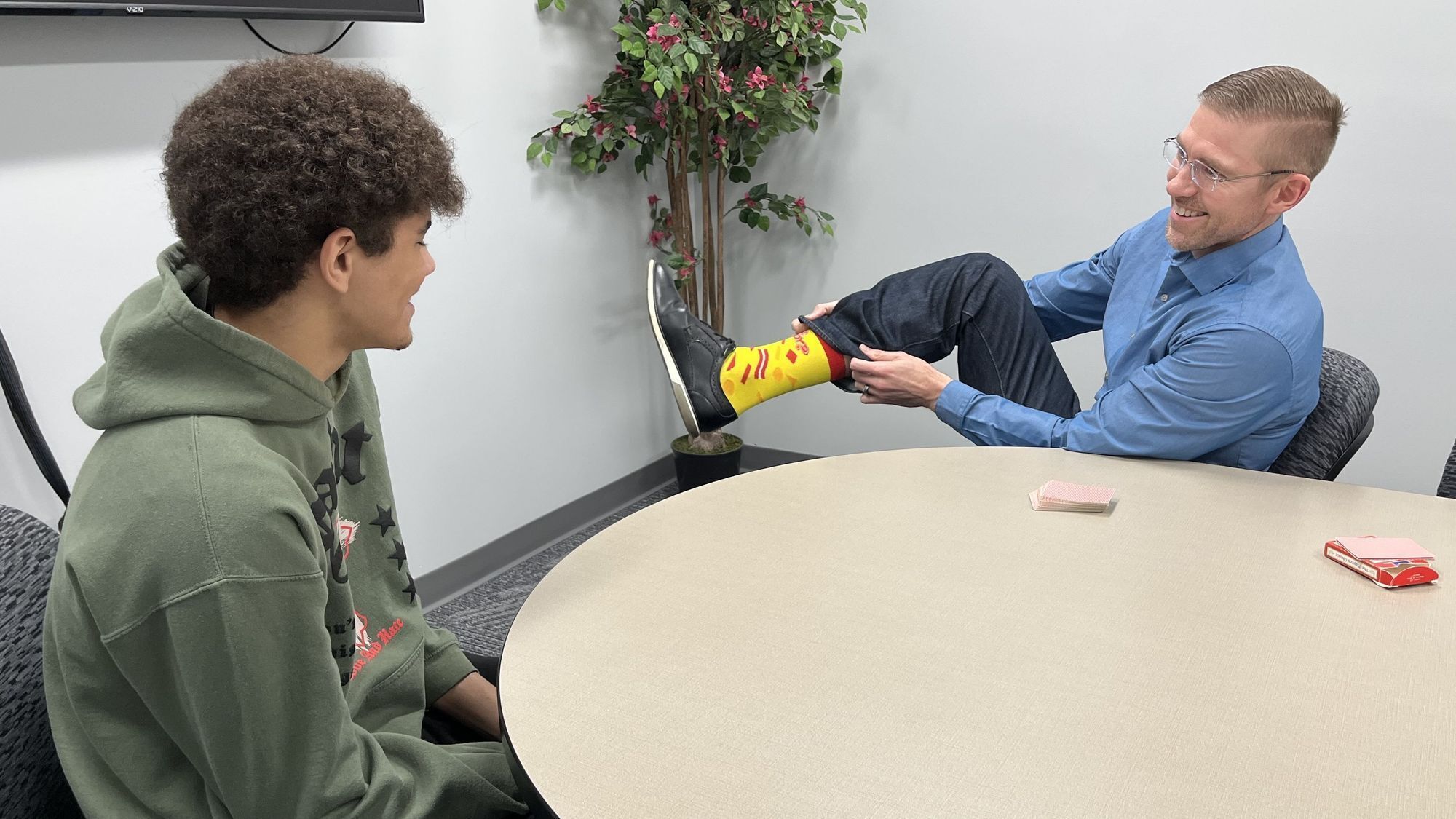
As the card game named Golf continued, discarded cards turning over quickly as the friendly competition went on, the conversation switched to an update on what had happened during the time apart. They shared stories of Christmas gifts, DeVries hiking up his pant leg to show the vivid yellow socks he got in a white-elephant exchange.
Then it was back to a discussion on quarterbacks, with DeVries urging Tavon not to give up on J.J. McCarthy too quickly and drawing him out on possible trades.
DeVries first met Tavon through his older brother, Tyreek, who is now 22. He was Tyreek’s mentor from second grade until his high school graduation. DeVries, married and the father of two children, says his family became close to Tyreek’s family, and he didn’t hesitate when it was suggested that he become Tavon’s mentor, too.
As Tavon nears graduation, their conversations often center on what the future holds. Every month or so they review Tavon’s grades, making sure he’s up to date with assignments or in need of extra credit. They talk about life, family, possible jobs and what Tavon might choose to do post-graduation.
“We talk about things dealing with character development, those things that last,” DeVries says. “I’ve told him that no one’s asked me about my (grade point average) in 25 years. But you have responsibilities, even if you don’t want to do them. It’s the effort, not the actual grade that matters.”
Tavon grins frequently during the card games and conversations. He chooses not to eat lunch during their time together, saying he’ll eat after school. A tray filled with food would take up too much table space during one of the twosome’s other favorite activities, a game of paper football. No one keeps track of who’s winning the most games of Golf, but Tavon filled up a page of scores during the paper-football season.
Sometimes his life seems too busy to squeeze an hour and a half away from work and family, DeVries says. That feeling never lasts long.
And during his second lunchtime at the middle school, his focus is entirely on the seventh grader, who chatters away when not asking the questions that will reveal whether the card attached to a plastic band around his forehead is of a bee or a toaster or a snail.
“Do I swim?” he asks DeVries, after slurping from a juice box. “Am I bigger than your shoe?”
DeVries has seen his mentee mature during the time they spent together. “You know I’m proud of you,” DeVries tells him, who smiles and nods.