
Chance Meeting Reveals Power of Foster Care and Adoption
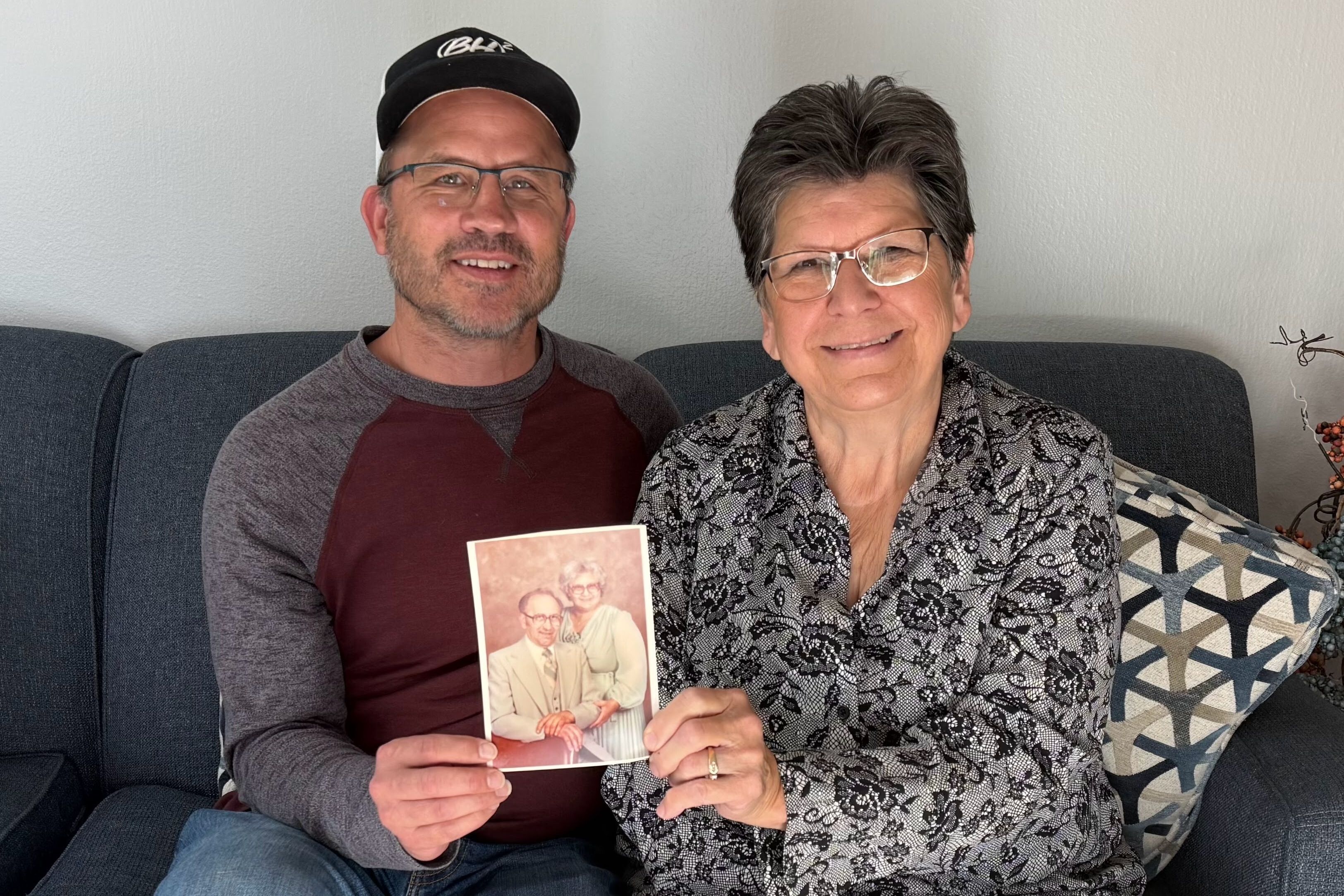
For a week in 1969, John and Mary Stahl loved the newborn boy entrusted to them as if he were their own.
So did their daughter, the youngest of the Stahls’ four children. Dorthea, then a sophomore at Washington High School, gladly helped her parents care for the infant, changing his diapers and holding him as he drank from a bottle.
Then, after seven days, the baby went home with his adoptive family. The Stahls prepared to welcome another infant in need of a temporary home, eventually taking in dozens over the years. No one realized that one day the baby, who had been named Brian Kittelson, and Dorthea, now Dorthea Schaefer, would meet again almost 56 years later.
That chance meeting has led both Kittelson and Schaefer to appreciate the significant impact that fostering and adoption has had on both their families.
Schaefer and two of her three siblings have adopted children, and one of her grandchildren is adopted. She learned early that fostering children meant giving them the best possible start before they join a permanent family.
“It was hard on me, when they were just little, to say goodbye, but it was a joy to know they would be going home with a loving family,” Schaefer said.
For Kittelson, meeting Schaefer and realizing the connection they shared was another step in learning about his personal history.
“My parents understand just how important these revelations and connections are for me,” Kittelson said. “They realize the more I learn about the early days of my life, the happier I’ve become, so they’re just happy for me that I’m experiencing these connections.”
John and Mary Stahl became foster parents through Lutheran Social Services of South Dakota, and Kittelson was adopted through the same agency. LSS, which was founded in 1920, began as a home for women experiencing unintended pregnancies. Over the years, it has branched into multiple other services, but its original purpose remains vital.
Crystal Treviño, adoption and foster care program manager at LSS, said the agency provides training and home studies for families hoping to adopt. LSS also works with women experiencing unplanned pregnancies, and if they choose to make an adoption plan, LSS assists the birth mother in selecting the prospective adoptive parents. The connection doesn’t end after the adoption is finalized.
“We’re there as long as they need us,” Treviño said. “They’re part of our LSS family. We’re here for the long haul. People call us 12, 15, even 50 years down the road.”
The adoption process has changed over the years, she said. Studies have shown how important it is for an infant to make an immediate connection with their caregiver.
“Whenever possible, we want that baby to go home with his adoptive family straight from the hospital,” Treviño said. “Back then, they didn’t place children directly with the adoptive family, whereas now we want the baby to go home with whomever is going to parent that child, whether that be the birth mom who has made a parenting plan or the family who is going to adopt. Attachment happens immediately, and we want the child to attach to his parents.”
As an agency, LSS makes sure that infants and adoptive parents are good matches and that it is done in the most ethical way possible, Treviño said.
That was the case when Kittelson’s parents learned in 1969 that a baby boy born in a Sioux Falls hospital was going to be theirs. Kittelson grew up knowing he was adopted, and while in graduate school in the 1990s, he began researching his past.
Kittelson learned that LSS would be able to do a search for his birth mother and communicate with her on his behalf. An LSS social worker encouraged Kittelson to write his birth mother a letter telling her about his life and explaining why he wanted to find her. She, too, had wanted to reconnect. After 25 years apart, they were reunited and developed a close relationship. He eventually met his birth father and got to know him as well.
A couple of years ago, Kittelson decided he wanted to learn more details about his adoption. LSS has stored all its adoption records for the past 105 years. Kittelson obtained his records and learned that after four days in the hospital, he had spent a week with foster parents named the Stahls. An online search for them came up empty, however.
Then one day earlier this fall, Kittelson met a woman named Dorthea Schaefer at work. The two started making small talk about food. Schaefer’s family heritage is Germans who had lived in Russia before immigrating to the United States, she said. That was Kittelson’s background, too, he told her, although because he was adopted, he grew up more familiar with Norwegian cuisine.
Schaefer then shared that she and her husband had adopted a daughter, that two of her siblings had adopted children and that her parents had fostered 72 children over the years.
“I said, wow, that’s a lot of kids, and I was envisioning older kids as it was typical with the foster system,” Kittelson said. “Then, she mentioned LSS. I said, wait a second. What were your parents’ names?”
Having seen the name listed several times in his adoption records from LSS, Kittelson recognized the name Stahl immediately.
Kittelson and Schaefer were shocked by their unexpected connection. It was especially meaningful because Schaefer knew that she had played an active role in tending to him as an infant. For Kittelson, it was as if a missing piece of a puzzle had been found.
John and Mary Stahl had started fostering infants when their daughter was in seventh grade. Schaefer said both her parents loved children and especially babies. Her father was just as hands-on with the infants as her mother. The Stahls continued fostering until the early 1990s when Mary’s health began to fail. She died in 1994, followed by John in 1996.
The family tradition continued, however. Over the years, one of Schaefer’s sisters fostered 75 children. Schaefer and her husband also have been unofficial foster parents for older children in need of a place to stay.
For Schaefer, meeting Kittelson was another reminder of the importance of foster care and adoption. For Kittelson, after meeting Schaefer and learning about the family who took him in as a 4-day-old until his adoptive parents could bring him home, some of the unknowns in his life, unknowns that many adult adoptees face, have gone away.
“Getting to know what kind of people the Stahls were and how they loved children means the world to me,” he said. “My parents, my birth mother and I have all been able to thank Dorthea for the care she and her parents provided me, and that means a lot to all of us.”